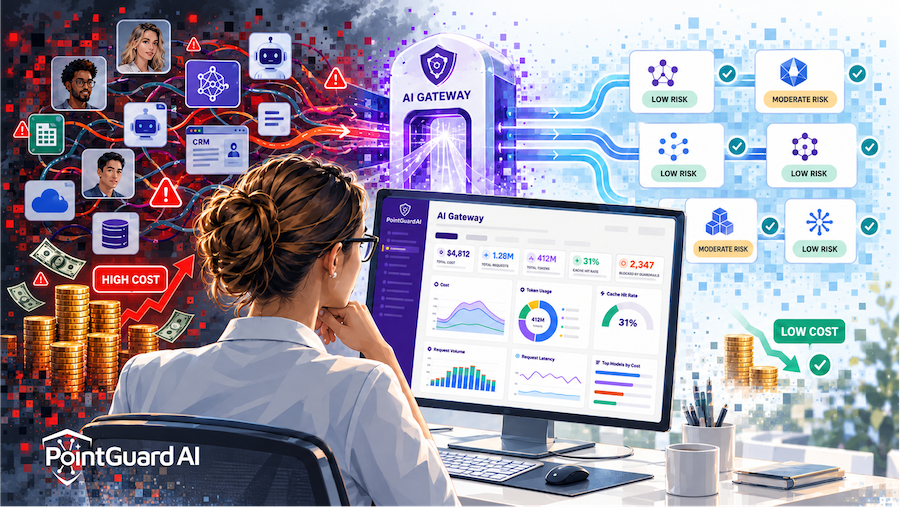
Enterprise AI adoption is creating a growing infrastructure challenge. Applications connect to multiple models, employees introduce new AI tools, and autonomous agents interact with enterprise systems. Each connection raises questions about access, sensitive data, reliability, and cost. As these interactions multiply, organizations need a consistent way to govern them without slowing the work AI is supposed to accelerate.
Today, we’re introducing PointGuard AI Gateway to address that challenge. It combines high-performance model routing, integrated security, and cost governance with the broader PointGuard AI platform. Enterprises gain a resilient foundation for expanding AI usage while connecting model access to the identity, data protection, observability, and runtime controls needed across their AI environment.
The challenges extend beyond model access
Connecting an application to a model is relatively straightforward. Maintaining control as hundreds of applications and agents make concurrent requests is considerably harder. Teams must determine which providers are approved, prevent sensitive information from leaving authorized boundaries, inspect interactions for threats, and maintain service when a provider becomes unavailable.
Autonomous agents introduce another dimension. A single task can trigger repeated model requests, retrieve external information, and invoke tools through Model Context Protocol (MCP) servers. Excessive permissions can expose enterprise resources, while repetitive agent loops can consume capacity and drive unexpected spending. These issues cross operational and security boundaries, making isolated controls difficult to manage.
A gateway therefore needs to do more than forward requests. It must provide an enforcement point that connects reliable model access with security policy, financial accountability, and the context needed to understand what applications and agents are doing.
Performance belongs in the security architecture
Security controls become difficult to sustain when they create a bottleneck. Developers need responsive services, and operations teams need infrastructure that can support growing concurrency. Gateway performance directly affects whether organizations can apply consistent controls across production workloads.
PointGuard AI Gateway uses a Java virtual-thread runtime designed to handle highly concurrent AI traffic. In benchmark testing involving thousands of concurrent requests, it delivered 50 times the throughput of LiteLLM. That result reflects the tested workload and configuration, while demonstrating the architecture’s capacity to support demanding enterprise environments.
Throughput is part of a broader design. Integrated guardrails inspect prompts and responses for injection attempts and sensitive data. Hardened software builds and build provenance strengthen software supply chain security. Together, these capabilities support a gateway architecture built to carry production traffic while applying the protections enterprise AI requires.
Resilience also matters. Health-aware routing directs traffic across approved SaaS, open-source, and in-house models, with automatic failover to configured backup providers. Centralizing these functions reduces the routing and recovery logic that application teams would otherwise maintain separately.
Make efficiency and spending enforceable
AI spending can become difficult to explain when credentials are shared and consumption is spread across applications, teams, and automated workflows. A monthly total offers limited guidance when organizations need to identify which workload consumed resources and whether that usage was justified.
PointGuard AI Gateway uses virtual API keys to scope access and attribute consumption by tenant, team, application, or workload without distributing underlying provider credentials. Hierarchical budgets, rate limits, and quotas turn spending policies into enforceable controls. Calendar-based resets help organizations manage recurring allowances across shared AI services.
Semantic caching addresses unnecessary inference. By recognizing semantically similar requests and serving suitable cached responses, the gateway can reduce repeated model calls and token spending while improving response times. This combines financial governance with architectural efficiency, helping teams expand useful AI capacity while avoiding redundant processing.
Connect the gateway to the entire AI security lifecycle
A model request rarely tells the whole story. Its significance depends on the application or agent making it, the authority behind that action, the data involved, and the tools used next. PointGuard AI Gateway connects these interactions to the broader platform so teams can govern AI as an interconnected environment.
Discovery and inventory establish visibility into AI assets and their relationships. Posture management and adaptive red teaming help teams identify weaknesses and test defenses. At runtime, integrated guardrails and AI Data Protection apply policies to live interactions. The gateway brings governed model access into this lifecycle.
Integration with MCP Security Gateway extends control to tool access and interaction inspection. Enterprise identity and on-behalf-of delegation preserve user context, helping ensure that access decisions reflect the authority behind a request. Model routing and tool authorization work together as complementary controls.
Agent Mission Control adds oversight across agent discovery, identity, observability, guardrails, and behavioral control. Agent Observability connects traces and security events to support investigation, while Guardian Agent provides intervention and containment when behavior requires a response. Endpoint controls extend governance to local agents and employee environments.
This shared context makes operational signals more useful. A consumption spike can be examined alongside identity, policy decisions, and agent activity. Teams can investigate whether they are seeing legitimate demand, a performance problem, or repetitive behavior that warrants action.
Build for the next stage of enterprise AI
The next stage of AI adoption requires infrastructure that can support scale and adapt as models, tools, and agent workflows change. Enterprises need dependable performance and clear accountability throughout that environment.
PointGuard AI Gateway brings these requirements together within our third-generation AI security platform. By connecting high-performance routing with security, cost governance, and platform-wide oversight, it helps organizations expand AI with the control needed to operate it confidently.
Explore PointGuard AI Gateway and request a demo to see how it fits into your enterprise AI architecture.

Watch Blog Video


Learn More