AI Gateway
Secure model access, agent tool use, and enterprise AI spending

Secure model access, agent tool use, and enterprise AI spending
AI gateways are becoming enforcement points for access to models and MCP servers. As enterprise AI scales, routing alone cannot address prompt injection, sensitive-data exposure, unpredictable spending, or excessive agent permissions. Organizations need resilient infrastructure that connects security, identity, observability, and cost governance across applications, coding agents, and automated workflows.
PointGuard AI Gateway:
Blocks unapproved shadow AI models
Prevents data leaks across AI interactions
Contains runaway costs with enforceable budgets
Scales reliably across enterprise AI workloads
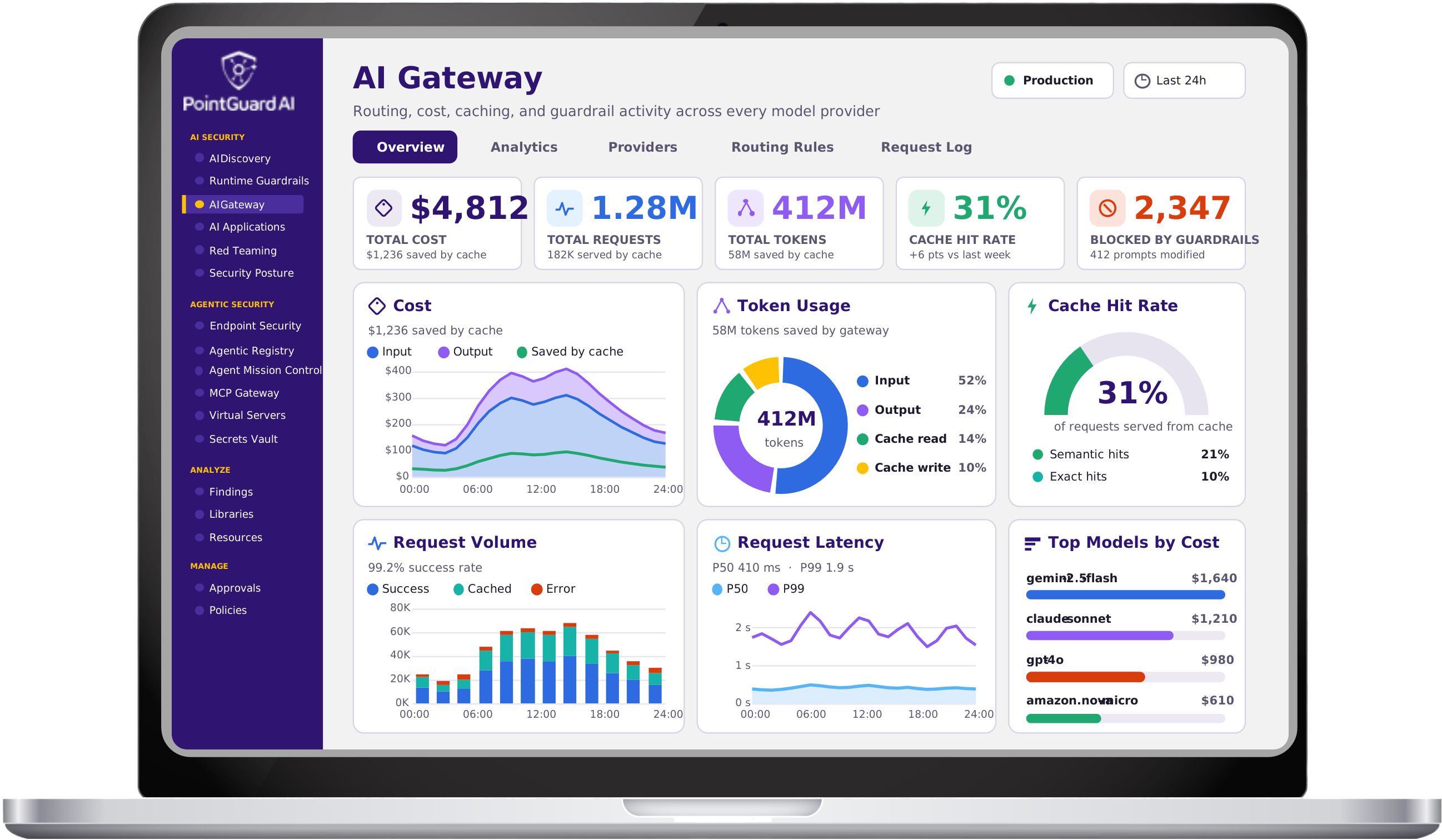
High-throughput routing connects approved SaaS, open-source, and in-house models with automatic failover, semantic caching, virtual keys, and hierarchical budgets. Integrated guardrails and data protection work alongside MCP Security Gateway controls to govern model interactions and agent tool access as enterprise workloads grow.
Scale enterprise AI with consistent security policies, resilient model access, accountable spending, and visibility across models and tools.
security and performance
Scale concurrent AI workloads with a hardened, secure-by-design gateway. Its Java virtual-thread runtime delivered 50x LiteLLM throughput with thousands of concurrent requests in benchmark testing. Integrated guardrails inspect prompts and responses for injection attempts and sensitive data, while software supply chain hardening helps reduce vulnerability exposure and disruptive emergency remediation.
Delivers benchmark-tested throughput of 50x LiteLLM
Inspects prompts and responses for threats
Protects sensitive data across AI interactions

routing
Route requests across SaaS, open-source, and in-house models through centrally approved providers. Health-aware routing and automatic failover redirect traffic to configured backups when providers become unavailable. Teams maintain consistent model access and security policies while avoiding separate routing and recovery logic in every application.
Restricts model access to approved providers
Redirects requests automatically during provider outages
Centralizes routing policies across enterprise AI workloads
optimization
Reduce repetitive inference by matching incoming prompts with semantically similar requests and serving suitable cached responses without invoking the upstream model. Teams lower token spending and improve response times for recurring questions and workflows, making shared AI services more efficient as demand grows across the enterprise.
Matches similar prompts beyond exact text
Serves cached responses without upstream inference
Reduces token spending on repeated requests


cost governance
Scope model access and attribute consumption by tenant, team, application, or workload using virtual API keys. Enforce hierarchical budgets, rate limits, and quotas without distributing provider credentials. Calendar-based resets and tenant isolation help teams govern shared AI capacity while maintaining clear financial responsibility across operations.
Scopes virtual keys by team or workload
Enforces rate limits, quotas, and budgets
Resets allowances automatically each calendar cycle
observability
Connect model usage, latency, failures, cache activity, and spending with identity and security policy events. OpenTelemetry streams support operational analysis and audit workflows. Monitoring helps identify consumption spikes and repetitive agent loops, so teams can investigate performance problems, excessive spend, and abnormal behavior using correlated gateway evidence.
Streams gateway telemetry through OpenTelemetry integrations
Correlates identity, usage, cost, and security
Detects unusual consumption and repetitive agent loops


governance
Connect model routing with MCP Security Gateway controls for tool discovery, authorization, and interaction inspection. Enterprise identity and on-behalf-of delegation preserve user context. SSO, role-based access control, in-VPC deployment, and audit records support accountable operations, while Intune configuration profiles distribute coding-agent and MCP policies across managed environments.
Continuously discovers and monitors enterprise AI
Governs model access and MCP tool use
Enforces tool permissions with delegated identity
Audits activity and distributes policies through Intune
PointGuard AI's third-generation AI security platform unifies LLM and MCP controls across north-south and east-west traffic. Prompt guardrails and data protection secure model interactions, while MCP Security Gateway applies identity-aware authorization and inspection to tool calls. Shared discovery, identity, and observability context connects policy enforcement with investigation and governance, giving teams consistent visibility across model access and agent actions.
Built for enterprise performance, its Java virtual-thread runtime delivered 50x LiteLLM throughput in benchmark testing. Scoped virtual keys, semantic caching, and hierarchical budgets combine scale with cost accountability. Hardened software builds and build provenance strengthen supply chain security, while in-VPC deployment and Agent Mission Control integration extend enterprise control and agent oversight.
Clients Words
AppSOC brings it all together in one intuitive dashboard – helping me prioritize vulnerabilities and ensure compliance.
Customer Spotlight
Learn More
Related Products
Our expert team can assess your needs, show you a live demo, and recommend a solution that will save you time and money.