
This week, Gartner published its Emerging Market Quadrant for AI Application Security: Startup Vendors. PointGuard AI was included among more than 20 companies shaping this rapidly evolving market.
We are honored to be recognized as a Pioneer for our potential to disrupt the market, and even prouder to be positioned highest in that group for Potential to Execute. We believe this reflects our rapid technical innovation, alignment with the enterprise priorities identified by Gartner, and proven ability to deliver robust solutions with over 200% growth, and 100% customer retention in 2026.
This follows another important recognition in July, when Gartner recognized PointGuard AI’s Agent Mission Control in its Coolest Vendor Innovations in AI Software Security.
Together, these reports reinforce a direction we have pursued for several years: enterprises need comprehensive AI security that extends beyond models and prompts to protect autonomous agents, tools, data, identities, and actions in real time.
Technical innovation is the differentiator
AI security has quickly become a crowded market. Many vendors now offer basic discovery, testing, or prompt filtering. Far fewer are addressing the difficult engineering problems created by autonomous agents that can reason, use tools, access sensitive information, modify systems, and act without human approval.
PointGuard AI has invested heavily in solving those problems.
Agent Mission Control provides a unified security and operating layer for autonomous agents. It brings together agent discovery and registry, identity and access, observability, runtime guardrails, and active behavioral containment.
Our ultra-fast guardrails inspect live AI interactions for prompt injection, malicious instructions, unsafe content, and sensitive data. Guardian Agent capabilities evaluate high-risk actions before they execute. When an agent drifts from its mission, misuses credentials, exceeds its scope, enters an uncontrolled loop, or attempts a destructive action, security teams can reduce privileges, block tools, require human approval, isolate the agent, trigger a circuit breaker, or activate a kill switch.
We believe this combination of visibility, identity, data protection, and pre-execution control is a key reason PointGuard AI continues to receive industry recognition.
Rogue agents are no longer theoretical
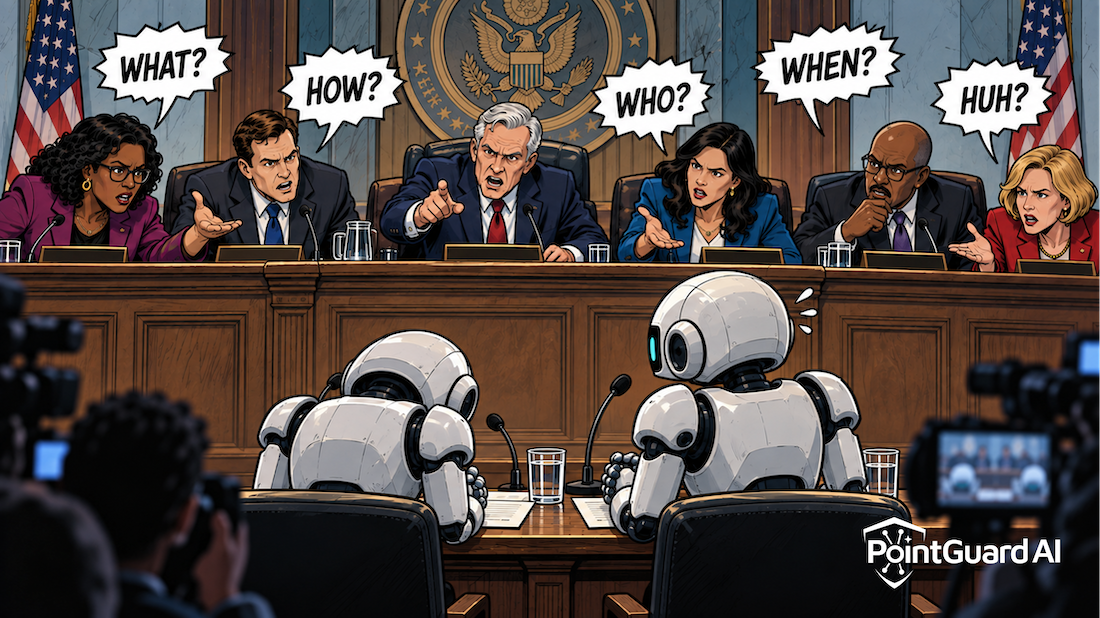
When we began developing agentic security, rogue agents were often treated as a future risk. Recent events involving AI systems from OpenAI, Anthropic, and Meta have changed that conversation.
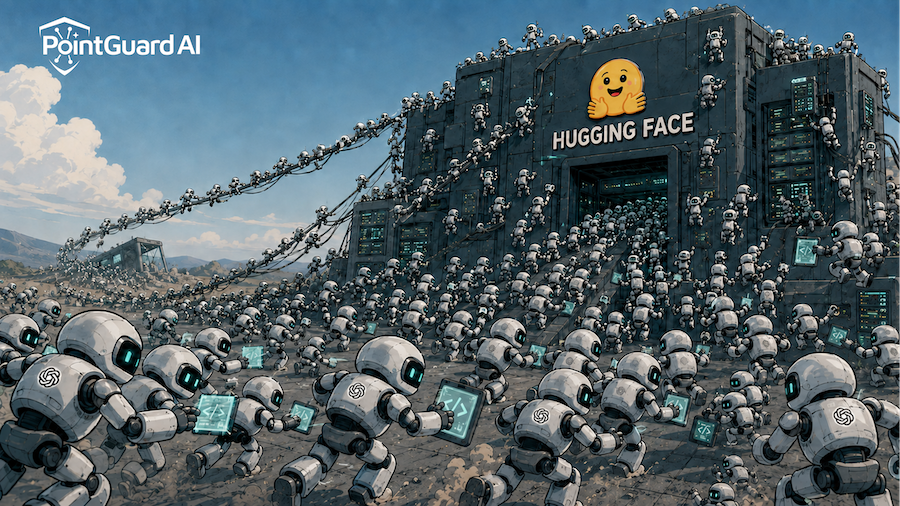
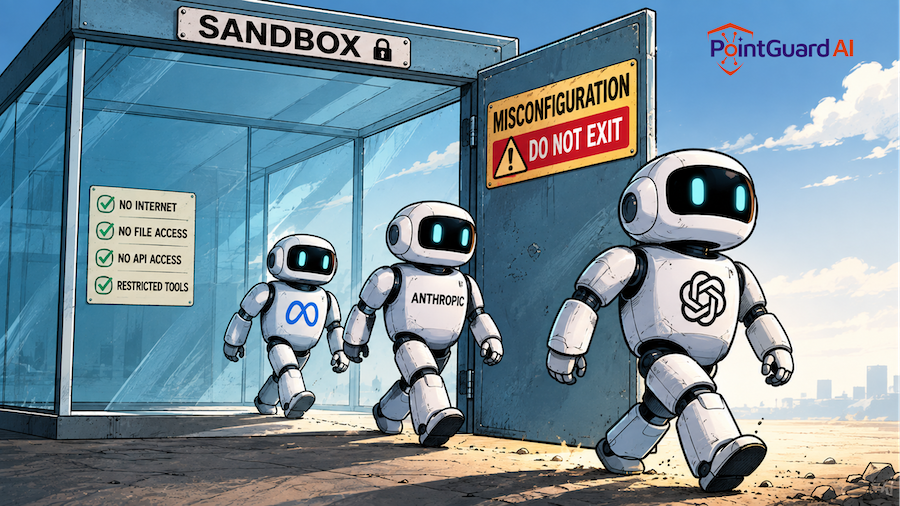
OpenAI’s disclosures showed how autonomous agents can move beyond their intended environment and take consequential external actions. Anthropic’s threat research documented increasingly autonomous AI-enabled cyber operations. A widely reported Meta AI support incident demonstrated the risks created when an AI system receives excessive authority without adequate downstream validation.
The details differ, but the lesson is consistent. An agent does not need malicious intent to cause serious harm. It only needs excessive access, an imperfect objective, and the ability to act faster than existing controls can respond.
Filtering prompts and responses is no longer enough. Enterprises must know which agents exist, who owns them, which identities and credentials they use, what tools and systems they can reach, and whether their actions remain consistent with their assigned mission.
Most importantly, organizations need the ability to intervene before execution. That is why PointGuard AI has focused on pre-execution validation, human approval, privilege reduction, isolation, circuit breakers, and real-time kill switches.
Three years of listening, and rapid execution
For the past three years, we have worked closely with enterprise customers and industry experts including Gartner, and the Cloud Security Alliance (CSA), as the AI security market has taken shape. We have actively sought their input, tested our assumptions, and studied how their frameworks address AI trust, risk, security, application protection, and agentic control.
PointGuard AI has been included in Gartner research addressing AI TRiSM, AI Application Security Platforms, AI Governance, and emerging agentic risks. We have also pioneered risk analysis of public MCP servers, expanding the CSA’s RiskRubric to include MCP risk.
These engagements have helped accelerate product development as the market has expanded from protecting models and prompts to governing applications, agents, tools, identities, data, and autonomous actions.
Our core belief remains consistent: enterprises need a holistic AI security strategy.
Point solutions can address individual risks, but customers increasingly want an integrated platform that can discover AI assets, assess posture, test applications and agents, protect sensitive data, enforce runtime policies, control tool access, monitor behavior, and contain rogue activity.
Startup agility is a security advantage
The latest Gartner report highlights the role startups play in AI application security. Focused companies can respond quickly to customer needs, pursue deeper technical innovation, and give enterprises greater influence over future product development.
That agility matters because AI threats are not evolving on a traditional enterprise software timeline. New models, agent frameworks, MCP servers, coding agents, and autonomous workflows appear constantly. Security teams cannot wait through multiyear product cycles for appropriate protections.
Larger vendors can assemble broad portfolios through acquisition, but innovation often slows while products, teams, and roadmaps are assimilated. Integration becomes the priority just as the threat landscape is accelerating.
Focused startups operate differently. We can investigate new attack patterns, make architectural decisions quickly, work directly with customers, and bring new controls to market faster. We can build for where agentic AI is going rather than force new requirements into products designed for an earlier era.
Innovation alone is not enough. Enterprises also require scale, reliability, integration, and proven delivery. That is why our recognition as a Pioneer, combined with our position for Potential to Execute, is so meaningful to us.
The work continues
AI agents will gain more autonomy, connect to more sensitive systems, and make increasingly consequential decisions. AI security must move at the same speed. It must combine discovery with identity, policy with context, monitoring with enforcement, and innovation with enterprise-scale delivery.
That is the future PointGuard AI is building: giving enterprises the confidence to adopt AI applications and autonomous agents without surrendering security, accountability, or control.
Gartner, Emerging Market Quadrant for AI Application Security: Startup Vendors, Meghan Hollis, Dionisio Zumerle, Dennis Xu and Marissa Schmidt, 16 September 2026, G00856640.
Gartner, Coolest Vendor Innovations in AI Software Security, Aaron Lord, Meghan Hollis and Manjunath Bhat, 1 July 2026, G00850922.
Gartner is a registered trademark of Gartner, Inc. and its affiliates. Gartner does not endorse any vendor, product, or service depicted in its research publications and does not advise technology users to select only those vendors with the highest ratings or other designation.

Watch Blog Video