

Detect and redact protected health information across ambient scribes, clinical copilots, patient chatbots, and agent tool calls.
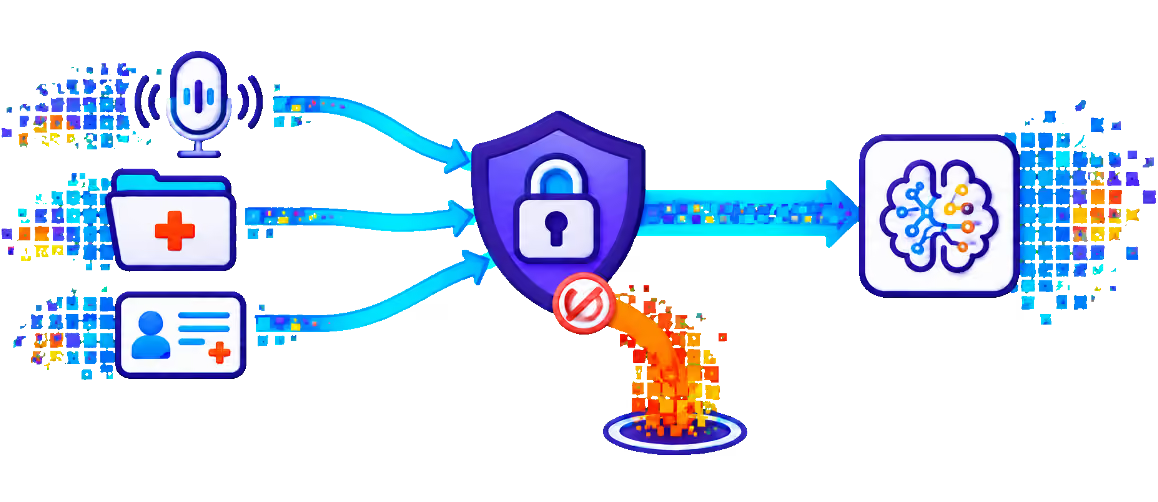
Ambient scribes, clinical copilots, and patient chatbots move protected health information through prompts, model responses, and third-party APIs every minute. Legacy DLP was built for email and file transfers, not for conversational AI or MCP tool calls. PointGuard AI applies PHI-aware data protection at each AI interaction point so clinical teams can use AI while patient data stays within approved, governed workflows.
PHI now travels through AI channels that existing data controls were never designed to inspect.
AI Data Protection, Runtime Guardrails, and MCP Security Gateway enforce PHI policies across clinical AI workflows.
1. Define protected data. Use built-in detectors for the HIPAA identifiers, medical record numbers, diagnoses, and medications. Add organization-specific identifiers and set permitted destinations for each AI application.
2. Inspect every interaction. Scan prompts, responses, and governed MCP tool calls for PHI at sub-100 ms latency, so clinical workflows are not slowed.
3. Redact or block exposure. Mask PHI when work can safely continue, and block interactions that would send it to an unapproved model, vendor, or user.
4. Record enforcement evidence. Log detections and actions for privacy officers and incident response teams. Map events to HIPAA and HITECH obligations to support breach assessment and audit.