[Read the Press Release on EIN]
We’re excited to introduce the next generation of AI security with the launch of the PointGuard AI MCP Security Gateway, a foundational control point built for the realities of agentic AI. As autonomous agents rapidly move from experimentation to production, they are no longer just generating content—they are interacting with enterprise systems, invoking APIs, and executing workflows across critical business infrastructure.
At the center of this shift is the Model Context Protocol (MCP), which is quickly becoming the standard for how agents connect to tools, data, and services. While MCP enables powerful interoperability, it was not designed with enterprise security in mind. As a result, organizations are exposing sensitive systems to agents with inconsistent controls, limited visibility, and unclear authorization boundaries.
A New Risk Layer for Enterprise AI
Agentic AI introduces a fundamentally different security challenge compared to traditional applications. Agents are dynamic, non-deterministic, and capable of interacting across multiple systems simultaneously. They can chain together actions, operate on untrusted inputs, and execute workflows at machine speed, often without direct human oversight.
This creates a new category of risk. Agents can access enterprise tools without strong authentication, operate with excessive permissions, and execute workflows influenced by malicious or manipulated inputs. In many environments, this leads to the emergence of “shadow MCP”—unmonitored agents and tool connections operating outside centralized governance. These risks are not isolated edge cases; they are structural gaps in how agentic systems are currently deployed.
Industry guidance is already pointing toward a solution. Gartner® has recommended that organizations “deploy AI/API gateways or MCP proxies to mediate traffic, enforce policies and monitor agent behavior continuously.” This reinforces a clear conclusion: agentic AI requires a dedicated control plane purpose-built for how agents operate.
The First Fully Integrated MCP Security Gateway
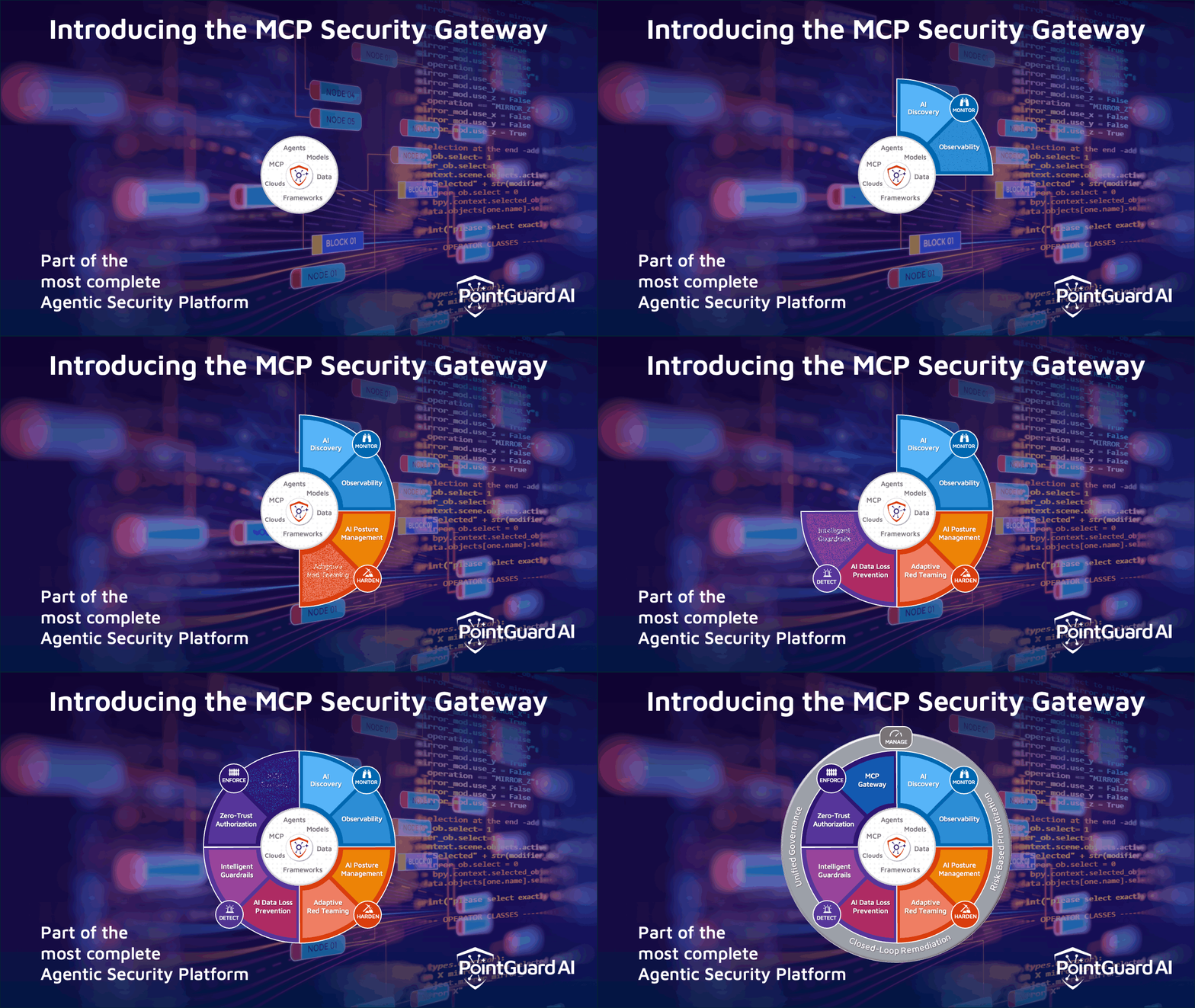
The PointGuard AI MCP Security Gateway introduces a new category of control for agentic AI environments. It is the first AI security platform with a fully integrated MCP Gateway, and the first AI gateway solution to unify discovery, authorization, guardrails, and data protection into a single control plane.
Unlike fragmented approaches that rely on multiple tools, the MCP Security Gateway brings together:
- Zero-trust authorization at the tool-call level
- Integrated DLP enforcement across agent workflows
- Real-time guardrails for prompts, responses, and actions
- Centralized discovery and inventory of agents, MCP servers, and tools
This unified architecture enables consistent governance across complex agent ecosystems and eliminates the gaps created by siloed solutions. It is not just a gateway—it is a comprehensive enforcement layer designed for enterprise-scale AI deployments. We believe this represents the most complete, enterprise-class AI security platform available today.
Zero-Trust Authorization for Agent Behavior
One of the most critical gaps in current AI deployments is the lack of granular authorization. In many environments, granting an agent access to a tool effectively grants broad, implicit permissions, creating unnecessary risk and exposure.
The MCP Security Gateway introduces intent-based, zero-trust authorization, evaluating every agent action before it is executed. This allows organizations to enforce least privilege at the level of individual tool calls and separate read, write, and update operations.
Policies can be applied per agent, per tool, and per workflow, ensuring that agents only perform actions aligned with their intended purpose. This level of precision is essential as agents begin to interact with financial systems, customer data, and operational processes where unintended actions can have significant consequences.
Guardrails and DLP Built Into the Workflow
Authorization alone cannot address the full spectrum of agentic risk. Agents can still be manipulated through prompt injection attacks, especially when malicious instructions are embedded within enterprise data or retrieved content.
The MCP Security Gateway embeds guardrails directly into agent workflows, enabling real-time inspection of prompts, tool calls, and responses. These guardrails detect and block unsafe instructions, preventing agents from executing unintended or harmful actions.
At the same time, integrated AI-native Data Loss Prevention (DLP) provides a second layer of defense by inspecting outbound responses and tool outputs for sensitive data. Even if an attack bypasses initial controls, DLP policies can block, mask, or redact sensitive information before it leaves the environment. This dual-layer approach ensures both proactive and reactive protection across agent workflows.
Context-Based Security: Moving Beyond Static Controls
What truly differentiates PointGuard is its approach to context-based security, which moves beyond static policies and single-dimensional signals. Traditional security models struggle to account for the dynamic and interconnected nature of agent behavior.
PointGuard evaluates risk across multiple contextual dimensions, including the agent’s role, real-time situational factors, behavioral history, and the trust relationships between agents, MCP servers, and downstream data sources. This allows policies to adapt dynamically based on how agents are actually operating within enterprise environments.
By incorporating context into every decision, the platform delivers more accurate enforcement, reduces false positives, and aligns security controls with real-world workflows. This represents a fundamental shift from rule-based security to intelligence-driven security.
Secure by Design: Built for the Agentic Lifecycle
Another key differentiator is PointGuard’s secure-by-design philosophy, which embeds security directly into the agent development lifecycle. Rather than treating security as a runtime-only concern, the platform enables organizations to build and deploy agents with governance and controls from the outset.
This includes governed prompt and resource management, integration with enterprise secrets vaults to prevent credential exposure, and human-in-the-loop approval mechanisms for high-risk actions. These capabilities ensure that agents are deployed safely and operate within clearly defined boundaries from day one.
This approach reflects the experience of the team behind PointGuard—industry veterans who understand that effective security must be integrated into both development and runtime environments.
Defining the Enterprise Standard for Agentic AI
Agentic AI is rapidly becoming a core part of enterprise infrastructure, but without the right controls, it introduces systemic risk that can scale as quickly as the technology itself. Organizations need a centralized way to govern how agents interact with tools, data, and systems across increasingly complex environments.
The MCP Security Gateway establishes that control point by combining zero-trust authorization, guardrails, DLP, and discovery into a single platform. It provides full visibility into agent ecosystems, enforces consistent policies across workflows, and protects both agents and the systems they interact with.
As enterprises move deeper into the agentic era, security can no longer be an afterthought or a collection of disconnected tools. It must be built into the architecture itself, and designed for how agents actually operate.
PointGuard AI was designed for this shift, and with the launch of the MCP Security Gateway, we are defining what enterprise-grade AI security looks like for the next generation of intelligent systems.
.avif)
Watch Blog Video