
AI agents are rapidly evolving from simple copilots into autonomous systems capable of retrieving data, making decisions, invoking tools, interacting with APIs, and executing business processes with limited human involvement.
That evolution creates major opportunities for productivity and automation — but also introduces entirely new security challenges. Unlike traditional software, AI agents are dynamic, adaptive, and heavily influenced by runtime context, external tools, memory, and other agents.
For CISOs, the challenge is no longer whether AI agents will be deployed across the enterprise. The challenge is ensuring they can operate safely, transparently, and within enforceable security boundaries.
This 12-point checklist outlines the core security controls organizations should evaluate before deploying autonomous AI agents at scale.
1. Visibility
AI agents can make decisions and perform actions at machine speed, often across multiple systems simultaneously. Without strong runtime visibility, organizations may not know what agents are doing until after damage has already occurred.
Comprehensive observability is essential for detecting abnormal behavior, investigating incidents, and maintaining operational accountability.
Key considerations:
- Log all agent actions, prompts, and tool calls
- Monitor runtime behavior continuously
- Correlate agent activity with existing security telemetry
- Detect abnormal or unexpected workflows
How PointGuard AI can help
PointGuard AI provides runtime observability and AI activity monitoring through its AI Runtime Defense and discovery capabilities, helping organizations gain visibility into live AI interactions and agent workflows. (Security Boulevard)
2. Identity
AI agents should be treated as privileged non-human identities with their own authentication, authorization, and lifecycle management requirements. Shared credentials or loosely managed tokens create unnecessary risk and make investigations far more difficult.
Every agent should have a cryptographically unique identity tied to clear permissions and auditable activity.
Key considerations:
- Assign cryptographically unique identities to each agent
- Separate agent identities from human user credentials
- Use short-lived tokens and credential rotation
- Continuously monitor agent authentication behavior
How PointGuard AI can help
PointGuard AI’s MCP Security Gateway supports zero-trust authorization, secure secrets management, and identity-aware controls for AI agents and MCP interactions.
3. Tool Access
Modern AI agents depend heavily on tools, APIs, and MCP servers to complete tasks. While these integrations expand agent capabilities, they also dramatically increase the enterprise attack surface.
Without granular access control, agents may gain unnecessary permissions or interact with untrusted external services.
Key considerations:
- Enforce granular access control through MCP
- Restrict agents to approved tools only
- Validate MCP servers and tool sources
- Audit tool usage and invocation activity
How PointGuard AI can help
PointGuard AI helps organizations govern agent access through its MCP Security Gateway, enabling granular tool permissions and centralized policy enforcement for MCP-connected resources.
4. Gateway Control
AI agents require a centralized policy enforcement layer capable of monitoring and controlling interactions in real time. Organizations need visibility not only into agent behavior, but also into the requests and responses flowing between agents, tools, and enterprise systems.
Strong gateway controls can help stop unsafe behavior before it becomes operational impact.
Key considerations:
- Inspect prompts, outputs, and tool requests
- Enforce centralized security policies
- Detect malicious or unauthorized behavior
- Block dangerous actions before execution
How PointGuard AI can help
PointGuard AI’s zero-trust MCP Security Gateway acts as a centralized control point for agent ecosystems, helping organizations inspect and govern agent interactions in real time. (EIN Presswire)
5. Runtime Guardrails
Static protections are insufficient for autonomous systems operating in dynamic environments. AI agents need runtime guardrails capable of enforcing security and safety policies continuously during execution.
Organizations should focus on preventing unsafe behavior in real time rather than relying solely on pre-deployment testing.
Key considerations:
- Prevent sensitive data leakage during execution
- Enforce DLP and AI safety controls in real time
- Detect prompt injection attempts
- Block unsafe or policy-violating actions
How PointGuard AI can help
PointGuard AI provides intelligent runtime guardrails with integrated DLP protection, prompt inspection, and policy enforcement for AI prompts, responses, and tool interactions.
6. Agent Intent vs. Action
One of the most difficult challenges in agentic AI security is determining whether an agent’s behavior still aligns with its original objective. Prompt injection, memory poisoning, or tool manipulation can subtly alter agent decision-making over time.
Organizations need mechanisms to identify when an agent’s actions no longer match its intended goals.
Key considerations:
- Monitor deviations between goals and executed actions
- Detect suspicious workflow changes
- Identify unauthorized task escalation
- Investigate anomalous reasoning patterns
How PointGuard AI can help
PointGuard AI helps organizations detect anomalous AI behavior and suspicious workflow activity through continuous runtime monitoring and AI threat detection. (Security Boulevard)
7. Containment
Autonomous systems can spread operational failures much faster than traditional software. A compromised or malfunctioning agent may rapidly propagate bad decisions across interconnected systems.
Containment strategies are essential for minimizing damage and maintaining operational resilience.
Key considerations:
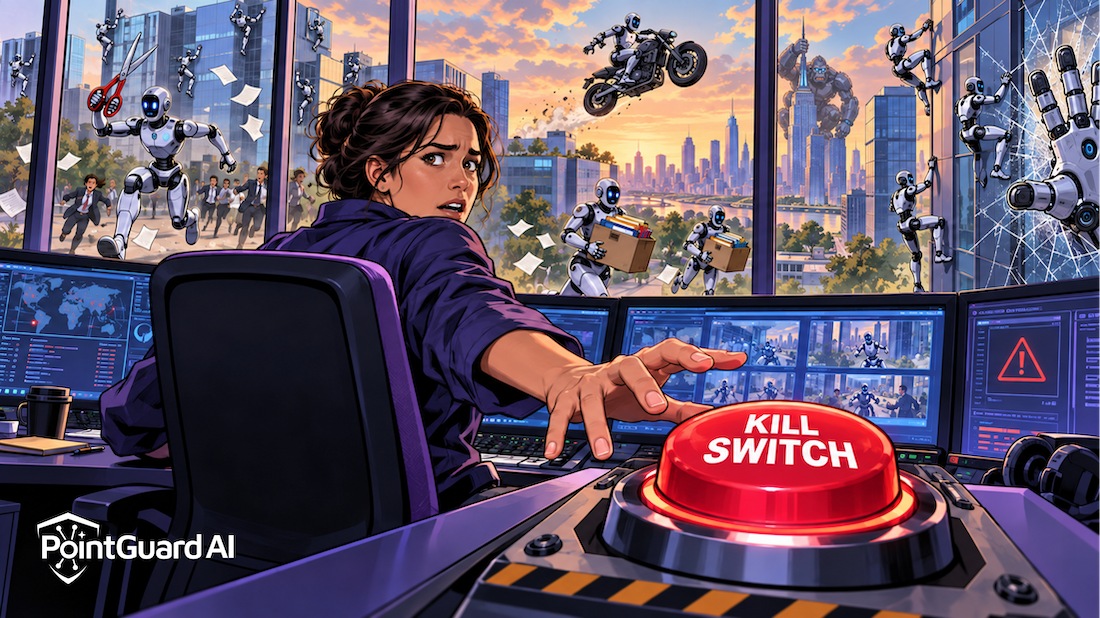
- Implement circuit breakers and kill switches
- Isolate compromised agents quickly
- Limit autonomous execution scope
- Prevent uncontrolled workflow propagation
How PointGuard AI can help
PointGuard AI improves operational visibility across interconnected AI systems, helping organizations identify and contain risky AI behavior before it escalates into broader operational impact.
8. Agent-to-Agent Communication
As multi-agent systems become more common, organizations must treat agent-to-agent communication as a critical security boundary. Poorly secured communication channels can enable impersonation, privilege escalation, or malicious instruction injection.
Every interaction between autonomous agents should be authenticated, monitored, and auditable.
Key considerations:
- Authenticate agent-to-agent communications
- Encrypt inter-agent traffic
- Monitor and log all agent interactions
- Prevent unauthorized delegation or impersonation
How PointGuard AI can help
PointGuard AI helps security teams monitor AI ecosystem interactions and enforce governance across interconnected agentic AI environments.
9. Human-in-the-Loop Controls
Not every decision should be delegated entirely to autonomous systems. High-risk actions involving financial systems, customer data, infrastructure, or compliance-sensitive operations may still require human oversight.
Organizations should establish clear approval checkpoints and escalation paths before granting agents broad autonomy.
Key considerations:
- Define mandatory approval checkpoints
- Require review for sensitive actions
- Establish escalation procedures
- Maintain auditability for human interventions
How PointGuard AI can help
PointGuard AI supports governed AI deployment with policy enforcement and human-in-the-loop approval workflows integrated into secure agent operations.
10. Cascading Failure Prevention
Interconnected agents can create chain reactions where one failure rapidly triggers others across systems and workflows. Without safeguards, small problems can quickly escalate into large-scale operational disruptions.
Organizations should build fail-safe mechanisms that limit the blast radius of autonomous behavior.
Key considerations:
- Prevent runaway execution loops
- Limit chained autonomous actions
- Implement fail-safe shutdown controls
- Monitor for systemic workflow anomalies
How PointGuard AI can help
PointGuard AI helps organizations reduce AI operational risk by providing visibility into interconnected AI assets, workflows, and runtime anomalies across distributed environments. (AiThority)
11. Agent Supply Chain Security
AI agents increasingly depend on external models, orchestration frameworks, plugins, prompt libraries, and MCP servers. This growing AI supply chain introduces many of the same risks already seen in traditional software supply chain attacks.
Organizations need visibility into every component powering their agent ecosystems.
Key considerations:
- Maintain a comprehensive AI-BOM
- Inventory all models, tools, and MCP servers
- Assess risk levels for third-party components
- Monitor for vulnerable or compromised dependencies
How PointGuard AI can help
PointGuard AI provides AI Discovery and AI-BOM capabilities that continuously inventory models, agents, MCP servers, datasets, and third-party AI dependencies across enterprise environments.
12. Compliance and Auditability
As AI agents become operational decision-makers, organizations will face growing regulatory and governance expectations around accountability and traceability. Security teams must be able to reconstruct what an agent did, why it acted, and what systems it affected.
Detailed logging and audit readiness will become foundational requirements for enterprise AI governance.
Key considerations:
- Collect detailed records of agent activity
- Preserve logs for investigations and audits
- Document agent permissions and workflows
- Align controls with compliance requirements
How PointGuard AI can help
PointGuard AI helps organizations strengthen AI governance and audit readiness through centralized visibility, runtime monitoring, and AI security posture management capabilities.
Securing the Future of Autonomous AI
AI agents are quickly becoming operational participants inside the enterprise. They can interact with sensitive systems, make decisions independently, and execute workflows at machine speed.
That fundamentally changes the security model. Traditional application controls were not designed for autonomous systems capable of adaptive reasoning and dynamic behavior.
Organizations that deploy AI agents successfully will be the ones that prioritize governance, runtime visibility, access control, and operational containment from the beginning.
As autonomous AI adoption accelerates, security leaders must treat agents not simply as software — but as powerful new digital actors operating throughout the enterprise.
.avif)
Watch Blog Video