The first generation of AI security focused on protecting models. Organizations invested in prompt filtering, AI gateways, red teaming, and data protection to reduce the risks associated with generative AI. Those capabilities remain essential, but they were designed for systems that generated content—not autonomous systems that reason, invoke tools, and execute business processes.
Enterprise AI has now entered a fundamentally different phase. Autonomous agents browse websites, call APIs, query databases, update business records, execute code, and collaborate with other agents. As AI evolves from answering questions to taking action, security must evolve from protecting models to governing autonomous behavior.
Recognizing this shift, Gartner recently introduced Guardian Agents as an emerging architectural category for supervising autonomous AI systems. Rather than another AI application, Guardian Agents provide an independent governance layer that continuously observes, evaluates, and intervenes in agent behavior across heterogeneous AI environments. This reflects the growing need for runtime supervision that extends beyond the controls built into individual AI platforms.
Today's enterprise AI environments are increasingly fragmented. Organizations are simultaneously deploying Microsoft Agent Service, Salesforce Agentforce, OpenAI Agents, LangGraph, CrewAI, Claude, internal frameworks, and thousands of Model Context Protocol (MCP) servers. Each platform includes security features, yet none provides complete governance across the broader enterprise.
As organizations embrace autonomous AI, they must answer new questions:
- Can this agent be trusted to perform this action?
- Does it have permission to use this tool or API?
- Is the request consistent with the user's original intent?
- Is the agent operating within approved business policies?
- Can risky actions be stopped before execution?
- Can thousands of autonomous agents be governed without slowing the business?
- Can runtime security keep pace with machine-speed AI?
These questions cannot be answered by prompt filtering or post-event monitoring alone. They require a runtime control plane that supervises every significant agent action before execution.
Runtime governance only works if it's fast
Performance is one of the least discussed—but most important—requirements for AI runtime security. Autonomous agents operate at machine speed. If runtime controls introduce noticeable latency, developers will disable them, users will bypass them, and governance will never scale across production environments.
Security leaders should ask:
- Can every agent action be validated before execution?
- Will runtime security slow autonomous workflows?
- Can content inspection keep pace with enterprise AI traffic?
- Can thousands of concurrent agents be governed without bottlenecks?
- Can security remain always-on instead of becoming optional?
The answers depend entirely on architecture.
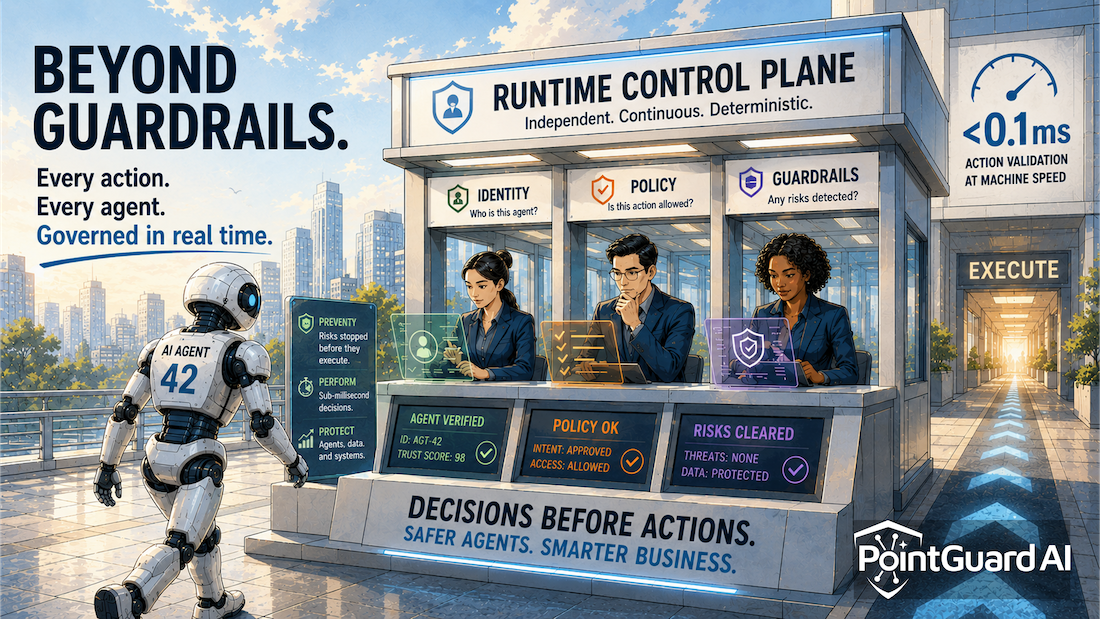
PointGuard AI was built specifically for enterprise-scale runtime governance. Agent Mission Control validates every agent action before execution with less than 0.1 milliseconds of latency, allowing deterministic policy enforcement without affecting agent performance. At the same time, High-Performance Runtime Guardrails inspect prompts, responses, tool requests, and AI-generated content in less than 0.5 seconds, protecting against prompt injection, sensitive data exposure, malware, jailbreaks, and policy violations while maintaining enterprise-scale throughput.
This combination enables organizations to enforce security inline rather than asynchronously. Every action is evaluated before execution, and every prompt and response can be inspected before sensitive information leaves the organization—without removing security from the critical execution path.
A unified runtime architecture
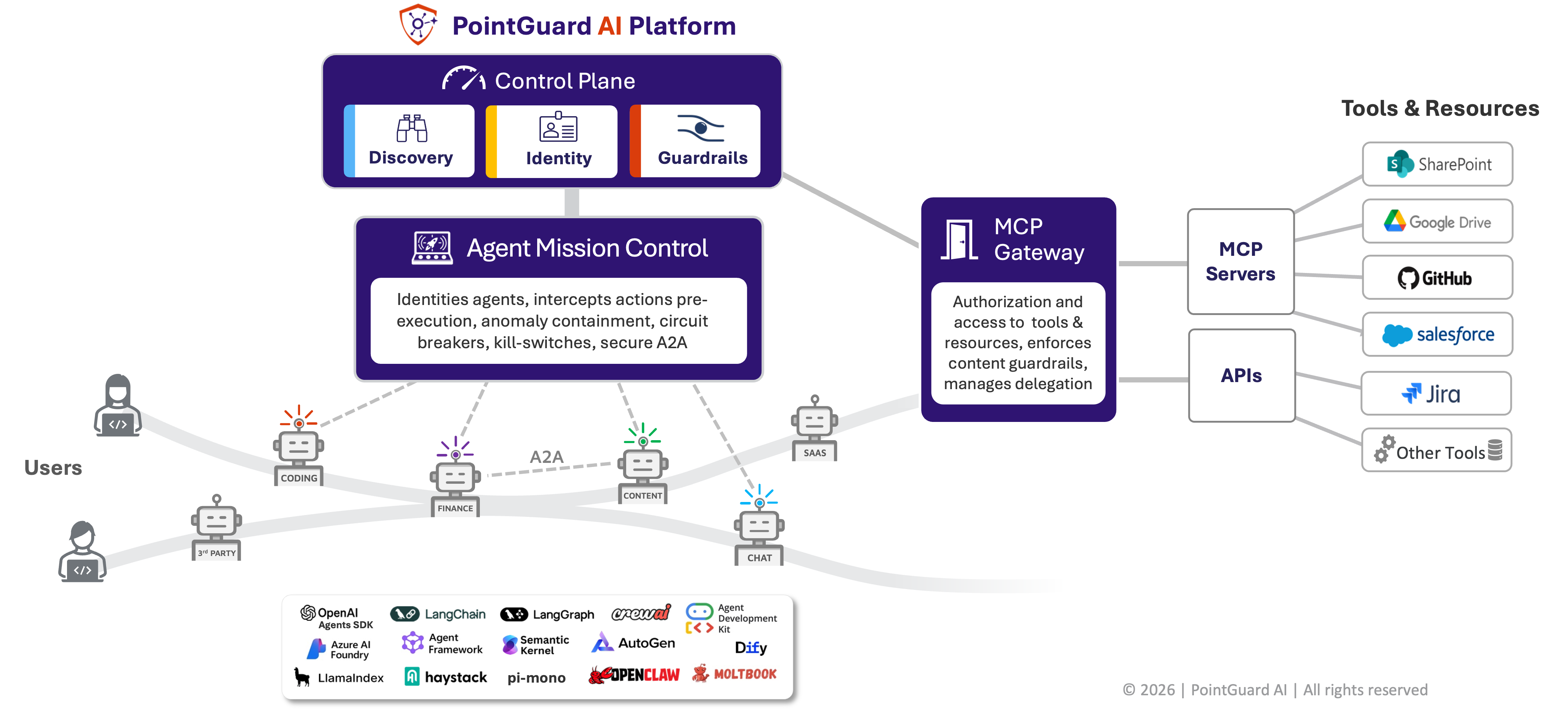
The diagram below illustrates how PointGuard AI implements a unified runtime control plane. Agent Mission Control, the MCP Security Gateway, and High-Performance Runtime Guardrails operate under a common policy engine, supervising every stage of autonomous agent execution rather than relying on disconnected point products.
Agent Mission Control provides continuous supervision
Every autonomous agent should operate under continuous supervision rather than complete independence. Agent Mission Control serves as the operational command center, evaluating every requested action in less than 0.1 milliseconds before execution. Instead of relying on the agent itself to decide whether an action is appropriate, an independent control layer verifies identity, evaluates policy, and authorizes execution based on deterministic rules.
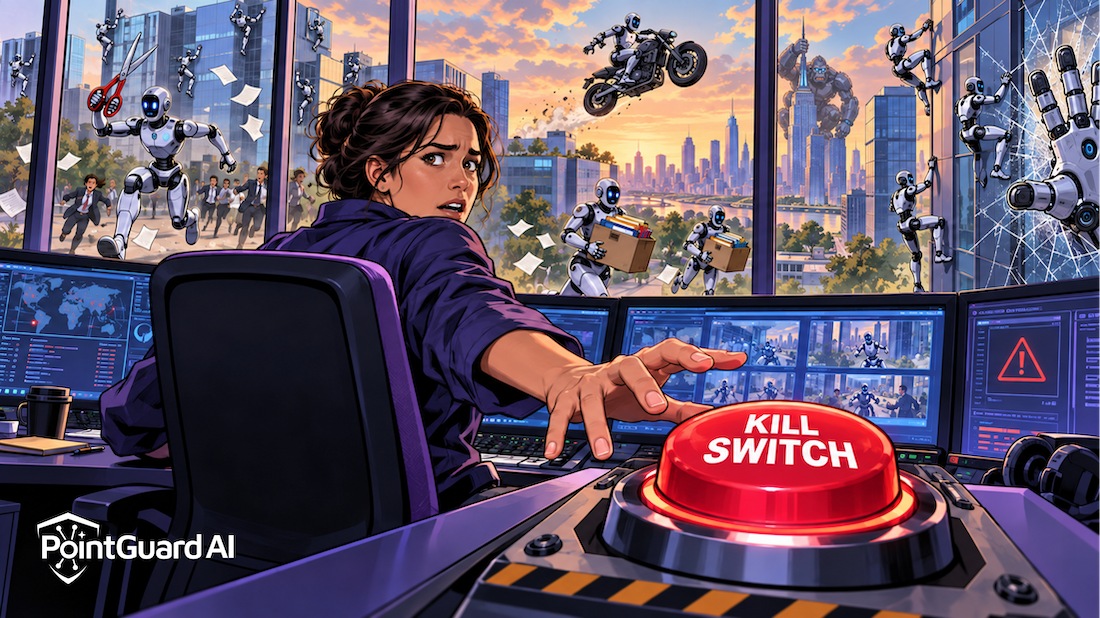
Every agent receives a verifiable cryptographic identity, every action becomes attributable, and every decision is fully auditable. Behavioral trust scoring continuously evaluates activity, while containment mechanisms such as kill switches, ring isolation, and sandboxing immediately stop rogue behavior before it spreads.
The MCP Security Gateway governs agent-to-tool communication
As the Model Context Protocol becomes the standard for connecting AI agents to enterprise systems, it also creates a significant new attack surface. Every MCP server becomes another pathway into enterprise applications, APIs, databases, and sensitive business data.
The PointGuard AI MCP Security Gateway provides centralized policy enforcement between agents and enterprise resources. It discovers authorized and unauthorized MCP deployments, enforces tool-level authorization, validates tool arguments, and safely connects legacy REST services through REST-to-MCP virtualization. Rather than trusting every tool invocation, the gateway ensures agents receive only the permissions required for their assigned responsibilities.
High-performance runtime guardrails enforce policy at enterprise scale
Runtime governance succeeds only if it keeps pace with autonomous AI. Modern agents can invoke tools, exchange information, and coordinate with other agents thousands of times per minute. Security that introduces noticeable latency quickly becomes a bottleneck.
PointGuard AI's High-Performance Runtime Guardrails inspect prompts, responses, and AI-generated content in less than half a second while Agent Mission Control validates every requested action in under 0.1 milliseconds. Together they provide inline protection against prompt injection, jailbreak attempts, malicious payloads, sensitive data exposure, and policy violations without slowing production workloads.
Instead of asking an LLM whether an operation appears risky, runtime guardrails evaluate concrete facts: identity, authorization, user intent, tool selection, requested parameters, data sensitivity, and organizational policy. Security decisions become predictable, repeatable, and enforceable regardless of which model or framework generated the request.
The future of AI security is a runtime control plane
Discovery, posture management, and AI testing remain foundational capabilities, but they are no longer sufficient on their own. As organizations deploy hundreds—or eventually thousands—of autonomous agents, the decisive control point becomes runtime, where agent decisions are evaluated before execution rather than investigated afterward.
Gartner's Guardian Agent architecture reflects this evolution toward independent runtime supervision across increasingly diverse AI ecosystems. Enterprises need a platform-neutral control plane capable of governing every agent regardless of the underlying model, orchestration framework, cloud provider, or application platform.
By combining continuous supervision through Agent Mission Control, secure agent-to-tool governance through the MCP Security Gateway, and enterprise-grade High-Performance Runtime Guardrails, PointGuard AI delivers a unified runtime architecture that keeps pace with autonomous AI while maintaining deterministic security.

Watch Blog Video